"Build for the future. Anything you put in community leaves a footprint. What type of footprint are you leaving?"
- Jonathan Moore, Founder and CEO, RowdyOr.Bit
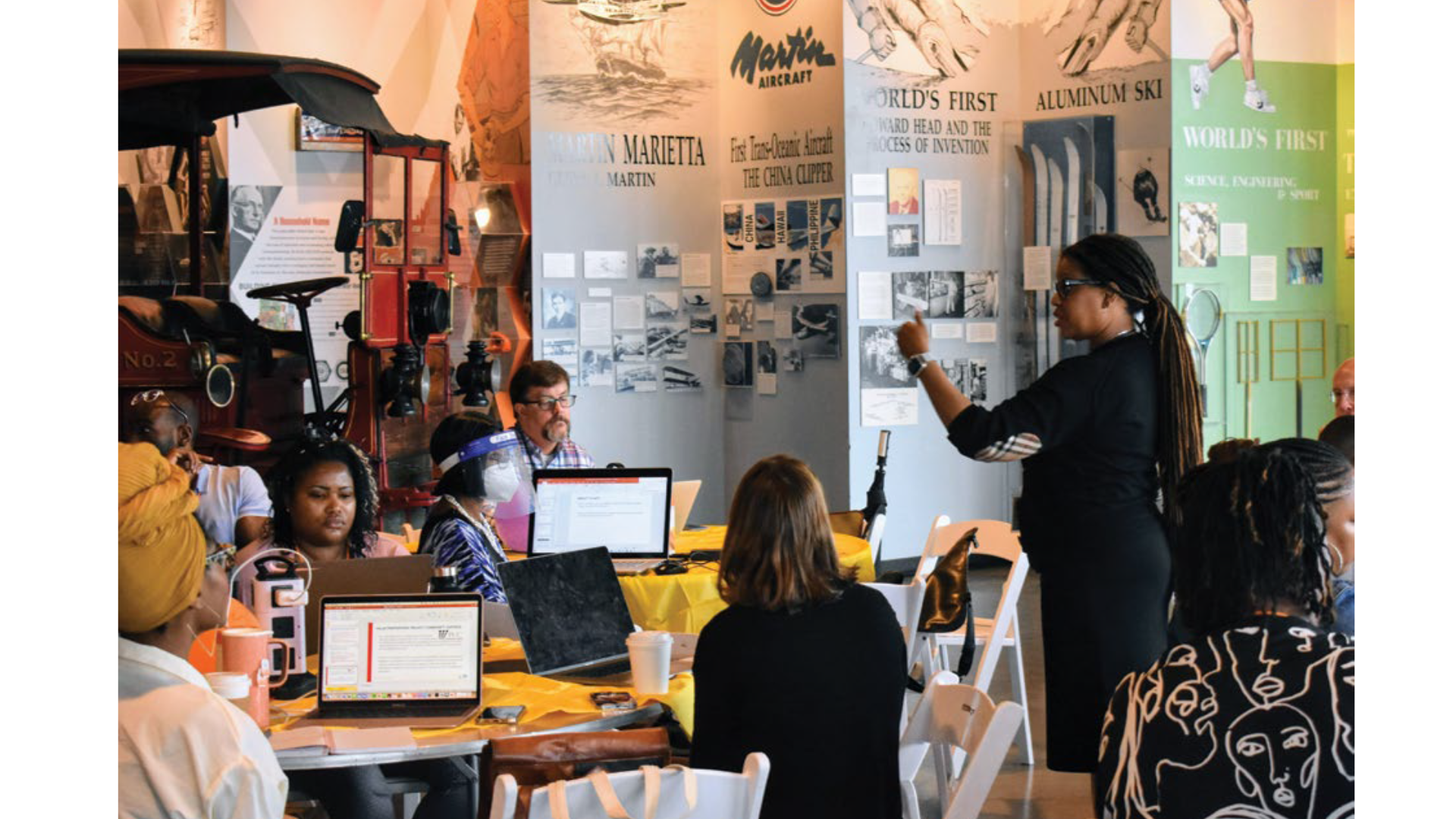
- Jonathan Moore, Founder and CEO, RowdyOr.Bit
With over a dozen academic and independent programs that support the Social Entrepreneur’s journey, Baltimore has a unique opportunity to become a leader in Social Innovation. Learn about trends and budding resources created to move social impact efforts further. The University of Maryland, Baltimore, released the State of Social Enterprise in Baltimore, a report that spotlights innovation and social entrepreneurship in Maryland.
It has often been said that the state of Maryland, in general, and the city of Baltimore in particular, has a unique opportunity to become a leader in social innovation. Despite a lower-than-average high school graduation rate, the state is among the highest in the percentage of the population holding advanced degrees. With the highest median income in the country, it is also clear that there is significant wealth available to support social concerns. Nationally, nonprofits employ 6.6 percent of the workforce, but in Maryland, that number is almost 11 percent — and that’s after subtracting for the largest nonprofit employer in the state. And it’s no secret that the region, and its largest city, are replete with deeply entrenched social problems.
In a predominantly Black city, the racial wealth gap continues to cause ripples across social and economic sectors. Whether it’s the civil disturbances that occurred after the 1968 assassination of Rev. Dr. Martin Luther King Jr., the more recent uprisings that occurred after the death of Freddie Gray, or the record-high per capita homicide rates, it is clear to most that Baltimore has deep wounds that have yet to properly heal.
While the basic notion of a venture that seeks to achieve a social objective while also earning income for the delivery of a product or service is nothing new (universities and hospitals have been doing it for centuries), the push for economically sustainable social programs in the modern era is generally linked to Bill Drayton, who first popularized the concept of social entrepreneurship in the early 1980s. Arguably, the watershed moment for this movement was Dr. Muhammad Yunus receiving the 2006 Nobel Peace Prize for his work founding and developing the Grameen Bank. A recent estimate developed by Social Enterprise UK suggests that there may be as many as 11 million social enterprises across the globe.
While many countries recognize a social enterprise as a distinct form of organization, there is no such format in the United States, making an estimate of the number of social enterprises in the U.S. difficult to determine — although it is generally recognized as being in the hundreds of thousands. One study suggested that over half of the nonprofits in the U.S consider themselves to be social enterprises. If correct, this could suggest that there are as many as 18,000 social enterprises in Maryland.
The state has been a leader in this movement in several ways. The first known social enterprise in Maryland is the iScan program founded by Humanim in the late 1990s. Almost 20 years ago, a group of funders launched a program that matched up MBA students at the University of Baltimore with area nonprofits to help develop earned income strategies, many of whom are still in business today — several with national reputations.
In 2007, we saw the launch of the Baltimore chapter of the Social Enterprise Alliance, a nationwide organization that seeks to “empower social enterprises to become sustainable and expand their impact.”
In that same year, Maryland Institute College of Art founded the Center for Social Design, one of several academic programs now in existence to support the aspiring social entrepreneur.
In 2010, Maryland was the first state in the country to recognize the benefit corporation, a unique form of corporate organizing that explicitly includes “a material, positive impact on society and the environment, as measured by a third-party standard, through activities that promote a combination of specific public benefits.” Unlike a traditional nonprofit, a benefit corporation can attract and reward private investors while still retaining a clear-cut social mission. This landmark legislation allows for social entrepreneurs to access a broader base of funding that is not available to the traditional nonprofit.
In 2012, a group of concerned individuals launched a monthly breakfast program that drew over 1,500 individuals over a year’s time to network and learn from one another. That effort led to the 2014 founding of Impact Hub Baltimore, a project that is still thriving on North Avenue in midtown Baltimore and the first of many organizations that now exist to support this community.
The Baltimore Development Corporation sees a substantial opportunity for the region to become a global leader in social enterprise, recently recommending that Baltimore-area leaders “invest in social innovation entrepreneurs by providing a platform and resources to bring solutions to social issues to market,” and it regards the development and expansion of social impact investing and support as key to realizing this opportunity.
The T. Rowe Price Foundation considers the development of strong leaders with effective management skills as essential to strengthening the nonprofit and social enterprise sectors of the Maryland economy.
Governor Wes Moore has called for additional resources to support funding for small and startup enterprises, particularly when those businesses can help to address social inequities. Governor Moore also has stated that Maryland’s future can be one where “we do not have to choose between a competitive economy and an equitable one.”
As with any entrepreneurial community, obtaining appropriate levels of funding that are available at the right time and under the right terms remains a challenge for the Baltimore social enterprise community. This issue is magnified by the need for capital sources that can withstand the longer repayment windows that are typical when a venture is trying to produce both social and economic value. Baltimore is also taking steps to fill this gap through programs like Ignite Capital, Conscious Venture Lab, and several small university-based programs. There is also a need for the various educational and support programs to improve collaboration among them so that the aspiring social entrepreneur is better able to navigate and assimilate the various resources and receive the appropriate level of support for each stage of its development.
Here, too, Baltimore is working to build this collaboration — one example being the recently founded Baltimore Entrepreneurial Leadership Network, which is building a community of practice to support those who direct these programs. With over a dozen academic and independent programs that support the social entrepreneur’s journey, Baltimore can now add a robust infrastructure to the list of assets and opportunities that exist to build this movement and bring about lasting social change in the region.
Coppin State University - Bachelor of Science in Nonprofit Leadership
Maryland Institute College of Art (MICA) - MA in Social Design
University of Baltimore - MS in Nonprofit Management and Social Entrepreneurship
University of Maryland, Baltimore - MS in Social Entrepreneurship
Johns Hopkins University (JHU) - Social Innovation Lab
Innovation Works - IW+MC Boost
Baltimore Corps - Elevation Awards
Loyola University Maryland’s Simon Center for Innovation & Entrepreneurship - Baltipreneurs Accelerator
Baltimore Social Enterprise Alliance
Conscious Venture Lab
Impact Hub Baltimore
Your path to success starts here
University of Maryland School of Graduate Studies. All Rights Reserved.